
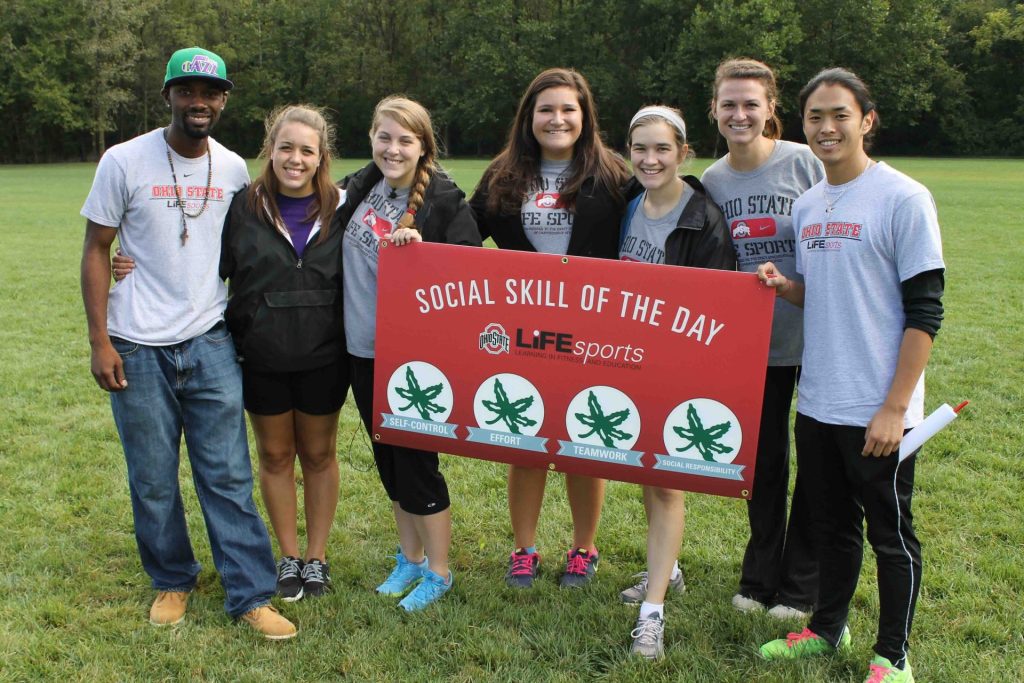
Q&A feature with Leanne Lower-Hoppe
November is a big month for sports–from the many Turkey Trots that will take off Thanksgiving morning to the rivalrous OSU vs Michigan Football game on November 30th. In recognition of the impact of sports in our community, we asked Dr. Leanne Lower-Hoppe to share insights on sports and human development.
Can you tell us about yourself?

My name is Leeann Lower-Hoppe and I am an Associate Professor of Sport Management in the Department of Human Sciences at The Ohio State University. I earned my BA in Math-Economics and Business Administration from Anderson University, during which time I competed as a cross country and track athlete and directed intramural sport programming and served as a camp counselor for an urban youth sports camp. I completed my MS in Sport Management from Baylor University, while assisting serving as a graduate associate for the university’s intramural sport program. I had the privilege of attending Ohio State and earned a PhD in Sport Management, with a concentration in development through sport, recreation and play. While at Ohio State, I served as the research coordinator for the Learning in Fitness and Education through Sports (LiFEsports) initiative. I have been a faculty member at Ohio State for eight years and partner with community sport organizations to support their design and delivery of sport programs for health and human development.
How did your personal and/or academic journey lead you to focus on sports for human development?
My interest in sport for human development began when I was very young. My parents work for a Christian sport organization called Athletes in Action that uses sport as a platform to share the gospel and develop moral character. Growing up my Christian faith and sport engagement were intertwined and helped me to see that sport is more than just a physical activity or means to an end but rather a mechanism for holistic development. In high school I participated in competitive track and cross country, but as an introvert struggled with confidence in social settings. It was through my participation in campus recreation that I learned to socially connect with diverse people and confidently navigate social environments. The personal development I experienced led me to conduct a thesis study on the social, cognitive and physical benefits of participation in campus recreation. Throughout my schooling, I had the opportunity to help run collegiate recreation programs and youth camps for socially vulnerable kids and saw first-hand the profound impact sport can have on people’s lives, spiritually, socially, emotionally, culturally, physically, etc. I continue to want to be a part of that impact.
Can you share an example from your research where a sports program had a positive impact on social or educational outcomes (for an individual or group)?
I had the privilege of partnering with Special Olympics Ohio to explore the physical literacy development of their athletes. Physical literacy encompasses “the motivation, confidence, physical competence, knowledge and understanding to value and take responsibility for maintaining purposeful physical pursuits/activities throughout the lifecourse” (Whitehead, 2013, p. 29). From our research, we found the lifelong, diverse sport program offerings; intentional divisioning of athletes to match ability; provision of adaptive sport accommodations; facilitation of premier State, National and World Games; and commitment of caring coaches facilitated athletes’ development of physical literacy. While the study focused on physical literacy, Special Olympics Ohio administrators, coaches and athletes shared the important role Special Olympics plays in athletes’ social development and well-being. Moreover, Special Olympics contributes to athletes’ identity, promotes a sense of belonging, celebrates athlete achievements, creates a public platform for athletes’ voice, provides opportunities for inclusion, facilitates relationship building and role modeling and is very fun.
How can sports organizations and community-based play practitioners promote belonging among the broader community?
Sport practitioners can promote belonging among the broader community through outreach initiatives, educational programming and community partnerships. At Ohio State, the LiFEsports initiative is a model example. The Senior Program Manager of LiFEsports Joe Ingram shared, “LiFEsports partners with university and city organizations to deliver impactful programming. Campus collaborators include Outreach and Engagement, Recreational Sports, Athletics and the College of Social Work, while community partners range from CMHA and CRPD to Dublin and Columbus City Schools, along with 50+ additional organizations. Together, we provide unique summer experiences that promote youth well-being through access to sport, social skill development, field trips, free transportation and meals and experiential learning opportunities such as career days and campus tours. Partners also engage directly through volunteer roles, the LiFEsports Games, and events that strengthen collaboration and community impact.”
How do you see the role of universities in advancing sports as a tool for human development?
I see universities advancing sports for human development in two primary ways: first, education, and second, sports programming. In Sport Management at Ohio State, our academic programs are designed to train the next generation of sport practitioners to manage sport organizations, many of which provide sport programs and services to the community (e.g., OSU Recreational Sports, Ohio State High School Athletic Association, Columbus Parks and Recreation). Through our curriculum, students are not only trained on the business of sport but also explore critical topics such as the psychology and sociology of sport, social issues in sport, leadership and coaching which will help them use sport as a tool for individual and community well-being. Universities also provide diverse opportunities for students to participate in sport through the collegiate athletic and recreation departments. Approximately 75% of students use on-campus recreation center facilities, programs and services (Forrester, 2014). Through recreational sport offerings, students are able to develop, maintain or improve their physical activity and healthy behaviors that can carry on past graduation for long-term health and well-being.
Why should people of all ages play or otherwise participate in sports?
Sport is a popular social institution, leading individuals to engage in physical activity, social interactions and entertainment rituals across the lifespan. COVID-19 era experiences have led to concerns about decreases in physical activity, increases in social isolation and worsening physical and mental health. Unfortunately, many of these public health concerns have persisted post-COVID. The CDC (2024) reported approximately 53% of U.S. adults and 39% of youth did not meet national physical activity guidelines in 2024, largely due to increasing sedentary behaviors and screen time. Further, approximately 23.4% of U.S. adults and 16.5% of youth experienced a mental health illness or disorder in 2024 (National Alliance on Mental Illness, 2024), with increasing social media use a key contributor (Primack et al., 2018). A recent APA poll estimates one in three Americans age 18-34 feel lonely every week (American Psychiatric Association, 2024). Sport is a powerful mechanism for promoting health and human development, which is a critical need in our society.
What emerging trends in sports organization are you most excited about, especially in relation to youth development or global engagement?
When surveying the sport industry, I am most excited about efforts to improve inclusivity and accessibility to sport experiences and increase awareness and support for mental health challenges. Unified intramural sport leagues at Ohio State are a prime example of inclusive sport, where people with and without disabilities come together on the same team to compete in sports, promoting social inclusion and integration. LiFEsports’ Coach Beyond initiative exemplifies prioritizing athletes’ mental health and holistic development by training coaches in several key areas:
- fostering a positive team environment
- improving mental strategies for athletic performance
- supporting student-athlete mental health
- developing leaders
- promoting life skills in student-athletes
- building a community of support
- promoting positive behavior and engagement
- managing stress and pressure as coaches
- practicing quality, balanced coaching.
I look forward to continued opportunities to partner with sport organizations across central Ohio to achieve these important aims.